Background
Good architecture makes software scalable, maintainable, and understandable. It’s essential from day one—not just for big enterprises.
Architecture erodes over time
Section titled “Architecture erodes over time”Erosion in regards to software architecture is a gradual process that can lead to an inefficient maintenance burden. It’s hard to maintain and not flexible. Studies show developers spend up to 70% of their time just understanding existing code.
Usually the amount of technical debts rises over the years. Without architecture guidance the structure of a codebase can become like spaghetti which is hard to maintain and barely flexible.
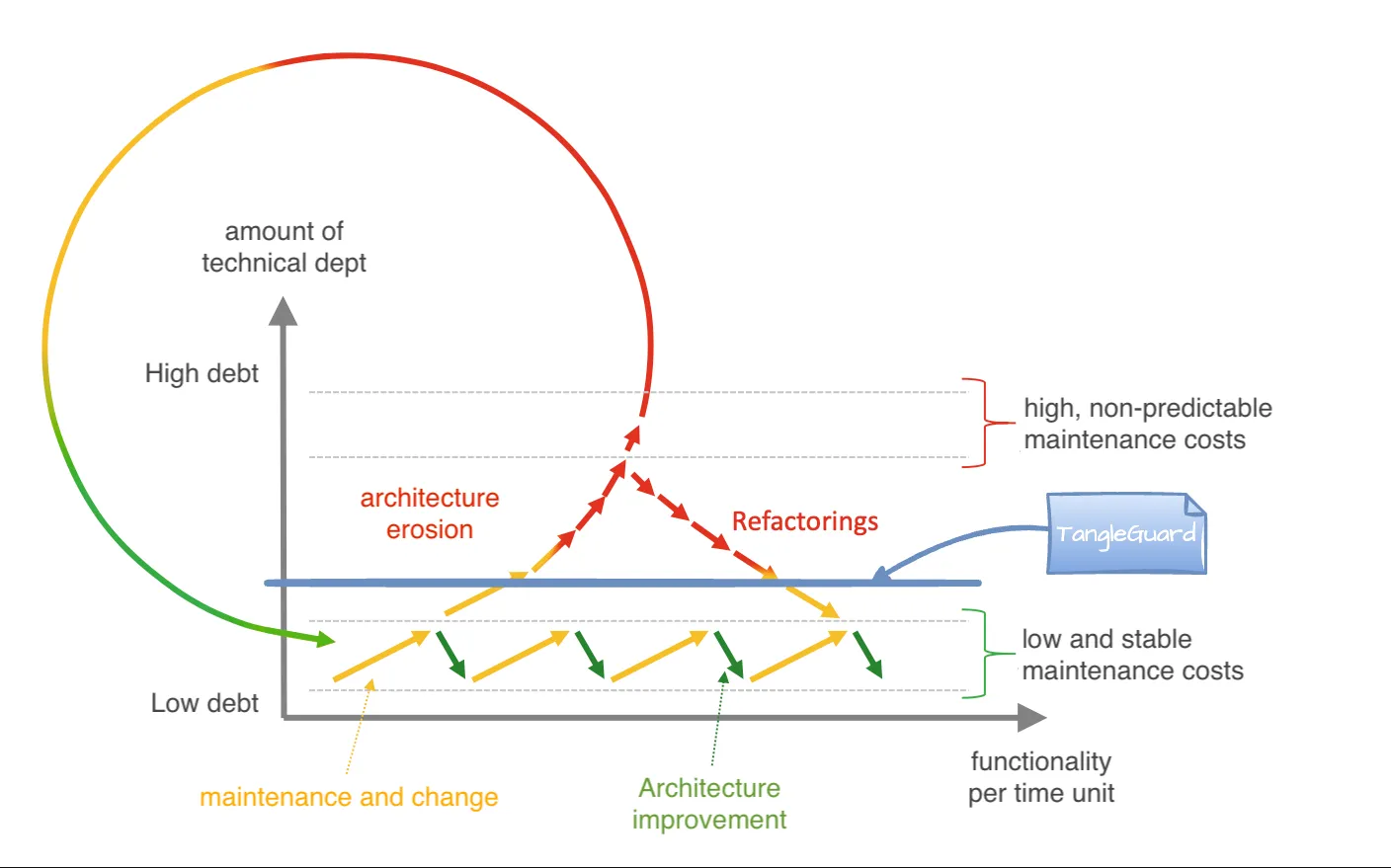
Source: C. Lilienthal - Sustainable Software Architecture - Analyze, limit and reduce technical debt (the blue colored content was added by Archwise Solutions U.G.)
This erosion reduced the productivity and increases the costs per line of code. Less code can be developed and hence less features can be added.
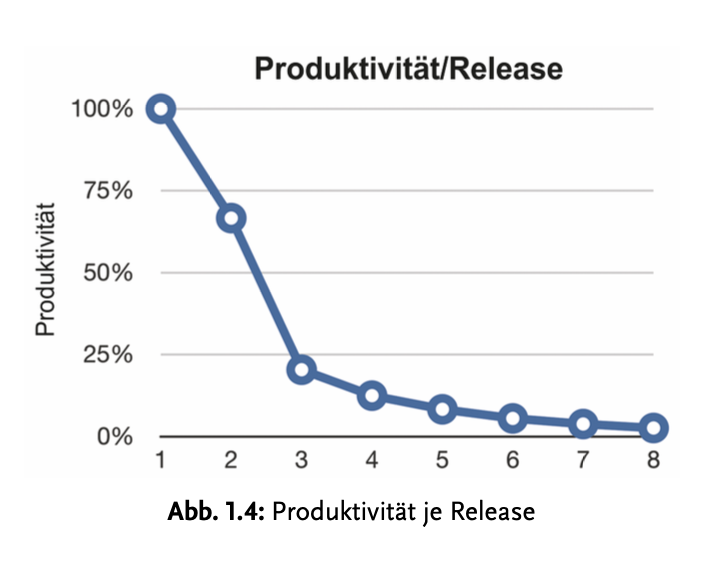
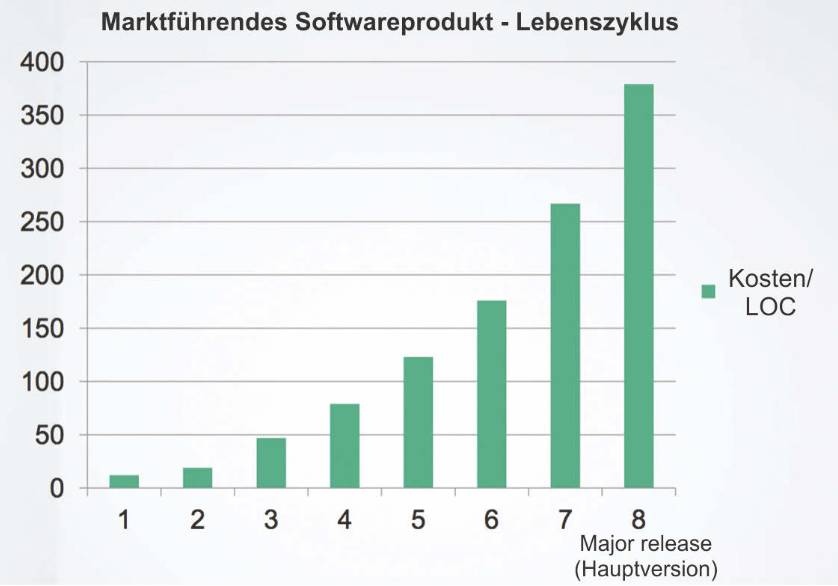
Source: Robert C. Martin - Clean Architecture
TangleGuard stops the erosion
Section titled “TangleGuard stops the erosion”TangleGuard stops architectural erosion and reduced the risk of having a tangled code structure before it becomes hard to maintain:
- Define clear architectural boundaries
- Enforce them automatically in CI/CD
- Catch violations immediately—not months later
- Keep maintenance costs low from day one
Think of it as lightweight architecture governance—modern, focused on code structure, not implementation details.
Architecture shouldn’t live in slide decks. It should live in your pipeline, protecting your codebase as it grows.
There are also different views on architecture, for example the deployment view or the runtime view. In TangleGuard we focus on components and the static relationships within the the source code of an application.
Here, software architecture consists of the following things. Architecture can feed abstract although it is very concrete and practical once you get the hang of it. To make it more tangible, visualization help help massively. It makes talk about the design easy and is a way to communicate a architecture which someone has in mind.
Components
Section titled “Components”In software development, the source code should be separated in one way or the other. Therefore you need to introduce boundaries which specify those separations. In TangleGuard components are one of the following:
- modules
- packages
- layers
Below You see two component A and B.
Component A depends on component B.
Components are visualized as rectangle whereas the dependency is visualized by the arrow as follows:
flowchart LR
  A --> B
For actual, real world examples, you can check out these examples made with TangleGuard.
Dependencies
Section titled “Dependencies”Whatever you choose as container to group your logic, it needs to interact with other component. Which component is being used by another component is specified via a dependency.
Layers
Section titled “Layers”A layer is a logical group of components, which groups similar components together. They also come with the constraint of only having specific dependencies between them.
Layers are implemented in TangleGuard in two ways:
- For a workspace, a layer is defined by a group of packages
- For a single crate, a layer is defined as a directory
Below are some general information about layers.
Technical Layers
For a classical layered architecture, layers are usually arranged in a hierarchy. Layers are only allowed to depend on layers below them.
flowchart TD
  LayerA --> LayerB
  LayerB --> LayerC
Let’s see an concrete example.
flowchart TD
    subgraph UI [API Layer]
        A[REST]
        B[GraphQL]
    end

    subgraph Service [Service Layer]
        C[Reports]
        D[Calculation]
    end

    subgraph Data [Data Layer]
        E[(Database)]
        F[(Cache)]
    end

    A --> C
    B --> C
    C --> D
    C --> E
    D --> F
Those groups can consists of technical components, like an API layer consisting of REST and GraphQL components.
We reference to those layers as technical layers or horizontal layers.
They are used by across business domains.
They are visualized as wide, shallow blocks in the architecture diagram.
Domain or Feature Layers
Layers can also consists out of feature components, which usually implement certain business logic.
An example of a domain layer would be to have a User layer.
It contains all components related to that user domain, like the API, models, services, etc.
They are also called vertical layers - they cut through the horizontal layers.
Below you see two vertical layers A and B.
flowchart TB
    subgraph F1 [Feature Layer 1]
      direction TB
      A[API]
      B[Service]
    end

    subgraph F2 [Feature Layer 2]
      direction TB
      C[API]
      D[Service]
    end

    A --> B
    C --> D
Dependency Rules
Section titled “Dependency Rules”Rules define to which components a specific component is allowed to depend on.
Currently in TangleGuard, you can define the depends_on relationship between components.
This is the fundament of the validator which keep your architecture in place.
Here’s how ti can be visualized: Allowed dependencies are marked in green. Not Allowed dependencies are marked in red.

Cohesion and Coupling
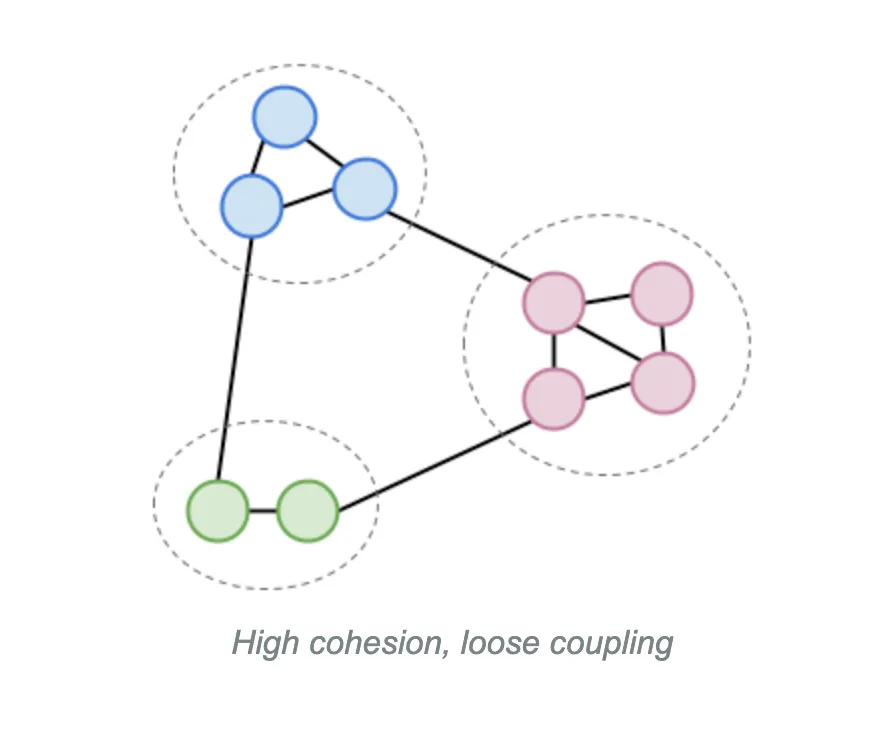
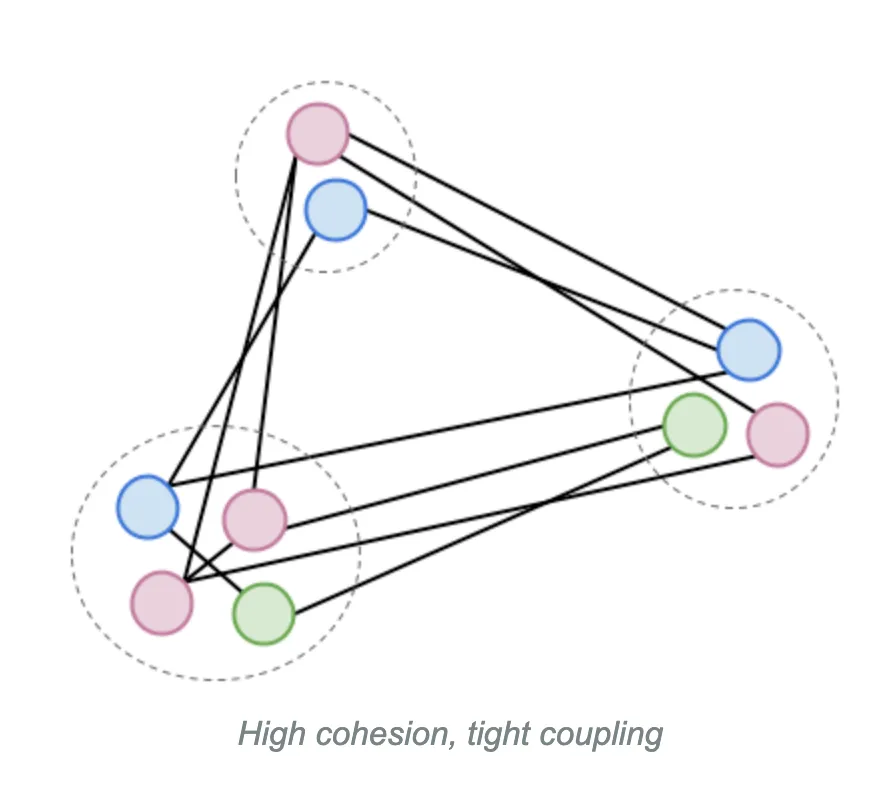
Section titled “Cohesion and Coupling”Cohesion and coupling are two important concepts in software architecture that help to ensure that components are well-designed and maintainable.
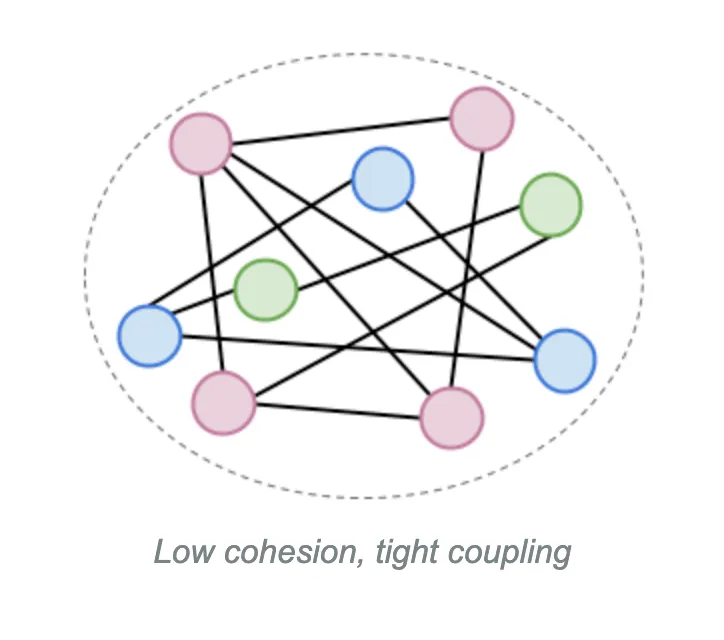
Cohesion refers to the degree to which the elements within a component are related to each other. A component with high cohesion has a clear and well-defined purpose, and its elements work together to achieve that purpose. On the other hand, a component with low cohesion has elements that are loosely related and may not contribute to the overall purpose of the component.
Coupling refers to the degree to which components are dependent on each other. A component with high coupling has a strong dependency on other components, which can make it difficult to modify or replace individual components without affecting the entire system. On the other hand, a component with low coupling has a weak dependency on other components, which makes it easier to modify or replace individual components without affecting the entire system.
For more details, visit https://blog.ttulka.com/how-cohesion-and-coupling-correlate/ - this blog contains a an excellent introduction to cohesion and coupling.
Depending on those characteristics, the architecture is either easy and cost efficient to maintain and or hard and expensive to maintain.
Architecture Evaluation
Section titled “Architecture Evaluation”When using TangleGuard you will see various graph diagrams which show the packages or modules of your application.
Each diagram represents a different view of your architecture, but the main focus is always the coupling and cohesion. With those you can make assumptions about the quality of your system regarding maintainability and flexibility.
- Try to identify how tightly or loosely coupled different parts of your system are.
- Look for patterns of high cohesion within modules — or the lack thereof.
- Diagrams showing high coupling may indicate areas where responsibilities are spread across too many components.
- Loose coupling and strong cohesion typically signal a more maintainable and modular design.
Understanding these diagrams is key to identifying architectural drift, erosion, and opportunities for improvement.
Easy to maintain
Section titled “Easy to maintain”Best you group your source code in a way that the components are cohesive and loosely coupled.
Below you see how this would look like [1].
You get such structure for example when applying domain driven design (DDD).
Harder to maintain
Section titled “Harder to maintain”A simple and common architectural style is the layered architecture as mentioned above.
If you don’t separate your code regarding feature or domain concerns, but rather regarding technical concerns, you will end up with a system which looks like the illustration below [1].
For each bug fix or feature you normally have to touch multiple components across the codebase which can easily lead to merge conflicts when working in a team.
Impossible to maintain
Section titled “Impossible to maintain”Below you see how an application can look like when you don’t separate at all [1].
You can what’s often referred to as a “spaghetti code” or “god object”.
This is very difficult to understand and hence maintain and proper isolated tests are very hard to write.
Sources
Section titled “Sources”[1] https://blog.ttulka.com/how-cohesion-and-coupling-correlate/